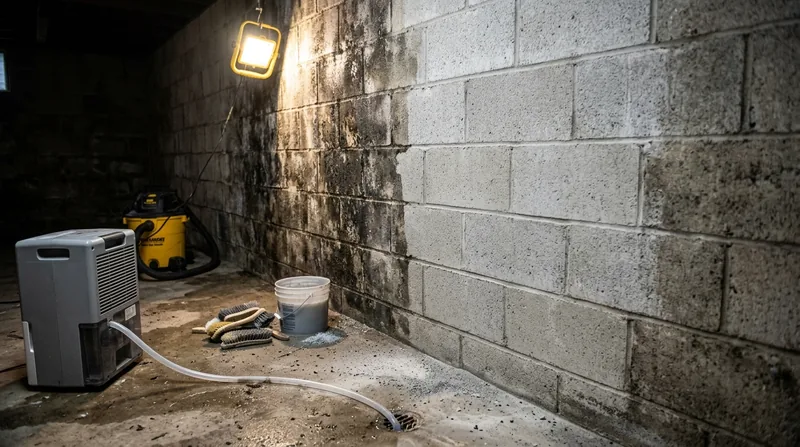




If you smell that damp, earthy odor the moment you come down the stairs, you are likely dealing with mold growth fed by a wet foundation. Basement Mold Remediation in Wilmington starts with finding the water source, not just scrubbing the visible spots. Along the Cape Fear River and the tidal creeks, the water table sits close to the surface, and sandy coastal plain soil over clay and shell does not drain fast. That means slab-on-grade homes in Ogden and Porters Neck, and raised brick-veneer cottages in Carolina Place and Forest Hills, all hold moisture differently. We treat the affected surfaces, dry the space, and fix the below-grade leak that keeps the mold coming back. Call (910) 765-8739 or start with a free basement inspection.
Why Basement Mold Grows So Fast in Wilmington's Coastal Building Stock
Wilmington homes face a specific combination: a shallow water table, humid summers, and heavy tropical rain that saturates the sand faster than it can drain. When hydrostatic pressure pushes groundwater through a foundation crack or a cold joint, the concrete stays damp, and mold growth starts on framing, drywall, and stored items within days. Older brick and frame cottages in the historic blocks are especially prone because their original parging and weeping tile have often failed.
- Water seeps through foundation cracks and wall joints after every heavy rain event.
- Efflorescence and white salt stains on the wall point to ongoing moisture migration.
- A failed sump pump or clogged discharge line leaves the sump basin overflowing during storms.
- High indoor humidity in summer keeps basement surfaces above the threshold for mold growth.
- Improper grading and short downspout extensions send roof water back against the foundation.
Each of these is a moisture pathway we can trace and correct before we treat the affected materials.
Key info: A 1960s brick ranch in Myrtle Grove had mold on the lower wall plate after a tropical storm. The cause was a failed footing drain, not a wall crack, so sealing alone would have brought the mold back within one wet season.
For official guidance on moisture and mold in homes, the EPA's mold resources at epa.gov/mold are a useful reference. Local permit questions go to the City of Wilmington building department, since rules vary and must be verified.
How We Run Basement Mold Remediation in Wilmington Homes
We do not treat mold without addressing the water. Our process begins with a musty smell diagnostic and a full below-grade inspection, then moves to containment and remediation of the affected surfaces. Once the space is dry, we correct the moisture source, whether that is a foundation crack, a failed drain tile, or a sump pump that cannot keep up with storm surge. You can see the full scope on our basement waterproofing page.
- We inspect the foundation, wall joints, and floor perimeter to locate the moisture source.
- We set up containment and negative air pressure to keep spores from spreading during removal.
- We remove and dispose of mold-damaged drywall, insulation, and framing that cannot be cleaned.
- We treat affected surfaces with an antimicrobial agent and HEPA-vacuum the space.
- We run dehumidification until framing and concrete reach dry standard readings.
- We repair the moisture pathway with crack injection, drain tile repair, or a sump pump upgrade.
Remediation without the moisture fix is temporary, so we always close with the waterproofing repair that keeps the basement dry.
Key info: A raised brick-veneer home near Wrightsville Beach had mold along the rim joist after a sump pump failure during a nor'easter. We replaced the pump, added a battery backup, and dried the framing before any surface treatment.
Remediation and Moisture Control Methods We Use
The right method depends on what is wet, how long it has been wet, and what is feeding the moisture. We match the approach to the material and the water source, and we explain plainly when simple cleaning is enough and when the foundation needs a real repair.
| Approach | Description | Best for |
|---|---|---|
| Surface treatment and HEPA cleaning | Antimicrobial treatment of concrete and framing, then HEPA vacuuming of the space. | Light surface mold on concrete walls and floor |
| Containment and material removal | Negative air pressure and removal of porous materials that cannot be cleaned. | Moldy drywall, insulation, and wood framing |
| Dehumidification and drying | Commercial dehumidifiers run until moisture readings return to dry standard. | Humid coastal homes and post-storm saturation |
| Moisture source repair | Crack injection, drain tile repair, or sump pump replacement to stop re-wetting. | Recurring mold tied to a wet foundation |
Every job ends with a dry standard reading, because mold returns wherever moisture is left behind.
Basement Mold Remediation Cost in Wilmington: What to Expect
Most basement mold remediation work in Wilmington starts from $1,500, and the final figure depends on how much material is affected and what moisture repair the foundation needs. A small patch of surface mold on a concrete wall with a simple crack repair sits at the low end. A finished basement with moldy drywall, saturated framing, and a failed drain tile system lands well above that. We give you a written scope so you can compare line by line. See the full breakdown on our pricing page.
- Square footage of affected surface drives the labor and material removal cost.
- Whether the affected material is porous (drywall, insulation) or cleanable concrete changes the scope.
- The moisture repair itself, crack injection, drain tile, or sump pump, is priced separately from remediation.
- Access matters: a low historic foundation with tight clearance takes longer than an open slab basement.
- Emergency storm response after a hurricane or tropical storm can add to scheduling and drying time.
Get two or three written estimates and compare what each one includes for moisture repair, not just surface treatment.
Basement Mold Remediation Near Me: How to Vet a Contractor Near Wilmington
Mold remediation and the waterproofing repair behind it are two different skills, and you want a contractor who does both. Ask for proof of licensing and insurance before work starts, and confirm the crew will handle containment and drying, not just spray and leave. Get at least three estimates and ask each contractor to explain the moisture source in plain terms.
- Confirm the company is licensed and insured and can provide a certificate on request.
- Ask for local references from homes with similar foundations, slab or raised brick veneer.
- Check whether structural foundation repair or drainage alteration requires a City of Wilmington permit.
- Ask how they verify dry standard before closing up walls.
- Get the scope and the moisture repair in writing before you sign.
Reach out through our contact page to schedule a free inspection and a written estimate.
Basement Mold Remediation in Wilmington: Pricing Guide
| Service | Price | Details |
|---|---|---|
| Surface mold treatment | Starting at $1,500 | Antimicrobial treatment, HEPA vacuuming, and drying for light mold on concrete walls and floors. |
| Containment and material removal | Starting at $2,800 | Negative air containment plus removal of moldy drywall, insulation, and framing; scope drives the price. |
| Remediation with moisture source repair | On estimate | Combines remediation with crack injection, drain tile repair, or sump pump work; needs an on-site look. |
| Travel | Included | In Wilmington and surrounding areas, no separate call-out or mileage fee. |
| Estimate | Free | Response within 24h at (910) 765-8739, no obligation to book. |
Indicative pricing, the exact cost depends on square footage, finish, and site access. Free personalized estimate within 24h at (910) 765-8739.


