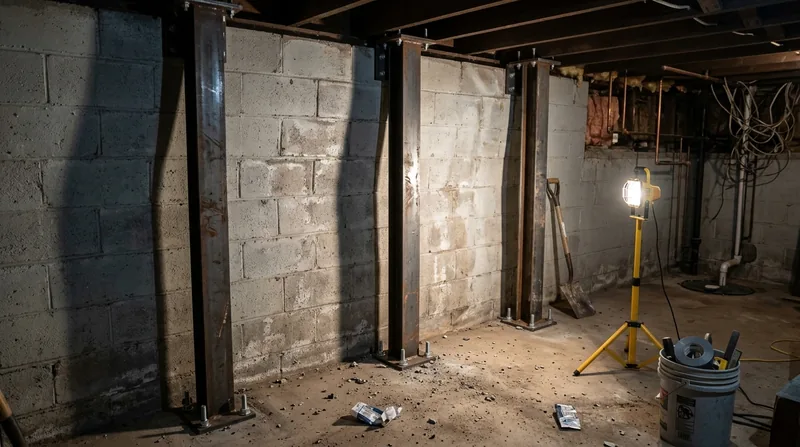




Bowing Wall Repair in Wilmington: When Saturated Sand Pushes Back
If you are searching for bowing wall repair in Wilmington, you already know something is wrong: a wall in your basement or foundation is leaning, cracking at the corners, or bulging inward after a wet season. Wilmington sits on sandy coastal plain over clay and shell, with the water table close to the surface. Full basements are the exception here, but raised brick-veneer foundation walls on 1920s to 1950s cottages in Carolina Place and Forest Hills, and brick ranches across Myrtle Grove, still take lateral load when storm rain saturates the sand and hydrostatic pressure builds behind the masonry.
We repair bowing walls with carbon fiber straps or steel braces matched to the severity of the movement. That means we measure the deflection, check the footing and the soil, and tell you plainly whether you need stabilization or just monitoring. If you want the full picture of how we handle water at the foundation, start with our basement waterproofing service.
Why Bowing Walls Show Up in Wilmington's Older Masonry
Our failure mode is not freeze-thaw. It is saturated sand and a rising water table after hurricanes, tropical storms, and days of coastal rain. When the ground cannot drain fast enough, water loads the back of the wall and the mortar joints open. You will see horizontal cracking at mid-height, a wall that is plumb at the top and kicked in at the bottom, and white efflorescence where moisture pushes through the brick.
- Homes in Carolina Place and Forest Hills often have original brick foundation walls with weak lime mortar that move under repeated wetting.
- Brick ranches in Myrtle Grove and Landfall can bow where downspouts discharge next to the foundation and grading slopes back toward the house.
- Slab-on-grade subdivisions in Porters Neck and Ogden rarely bow, but their foundation walls still crack at the corners when the water table rises.
- Low lots near tidal creeks, marsh, and the Cape Fear River take storm surge and heavy rain faster than the sandy soil drains.
In every case, the repair has to address the pressure behind the wall, not just the crack you can see.
Key info: A 1948 brick cottage near Forest Hills showed a 1.5-inch inward lean at mid-wall after a tropical storm. The cause was a failed footing drain and a downspout dumping into the same corner. Carbon fiber straps stabilized the wall, and correcting the drainage removed the pressure.
For structural foundation repair, permits are commonly required, and thresholds vary by jurisdiction. Verify the current rules with the City of Wilmington's building department before work begins: City of Wilmington.
How We Diagnose and Stabilize a Bowing Wall in Wilmington
We start below grade, not at the cosmetic crack. The goal is to find out whether the wall is still moving, what is loading it, and how much deflection the masonry can tolerate. We measure plumb, map the cracks, check the footing drain and grading, and look for water staining and efflorescence that show the wetting pattern.
- We inspect the wall from inside and outside, measure the deflection, and photograph the crack pattern.
- We check the footing drain, downspout discharge, and grading to find what is feeding the pressure.
- We recommend the lightest repair that will stop the movement: carbon fiber straps for moderate bowing, steel braces or anchors for heavier loads.
- We install the system, restore the wall surface, and correct the drainage that caused the problem.
- We schedule a follow-up measurement so you can see whether the wall has stabilized.
If the wall is wet as well as bowed, we often pair the repair with an interior drain tile system to relieve hydrostatic pressure at the footing.
Key info: On a raised brick foundation in Carolina Beach, the wall was bowing toward the interior and the footing drain was clogged with sand. We installed carbon fiber straps and cleared the drain path, then extended the downspouts. Two seasons later, the deflection reading had not changed.
Bowing Wall Repair Methods We Use
Not every bowing wall needs the same fix. The right method depends on how far the wall has moved, how tall the wall is, and whether the pressure is still active. Here is how we match the repair to the severity.
| Approach | Description | Best for |
|---|---|---|
| Carbon fiber straps | Strong, low-profile straps bonded to the wall and anchored top and bottom. | Moderate bowing with cracks but no footing movement. |
| Steel braces | Vertical steel beams set against the wall and tied into the floor structure. | Taller walls and heavier lateral loads. |
| Wall anchors | Plates on the inside tied to anchors driven into stable soil outside. | Walls that are moving outward as well as bowing. |
| Epoxy injection | Structural epoxy injected into cracks to rebond the masonry. | Hairline to moderate cracks that are not actively leaking. |
| Drainage correction | Footing drain repair, downspout extensions, and regrading to relieve pressure. | Any bowing wall where water is the driver. |
We choose the method after measuring the wall, not before, because a strap on a wall that is still being pushed by water will only delay the next crack.
Bowing Wall Repair Cost in Wilmington: What to Expect
Pricing for bowing wall repair starts at $600 for minor stabilization and drainage correction, and rises with the number of straps, the height of the wall, and whether the footing drain needs work. A single-wall carbon fiber job on a brick ranch in Myrtle Grove is a different scope from a full perimeter anchor system on a historic cottage near the river. Access matters too: a wall behind finished basement space or tight to a property line takes more labor.
We give you a written scope with the measurement and the recommended method, so you can compare estimates on the same basis. Get two or three estimates and ask each contractor how they measured the deflection and what they plan to do about the water pressure. Our pricing overview shows the full range of work.
Hiring a Bowing Wall Repair Contractor Near Me in Wilmington
Ask for proof of license and insurance before anyone touches the wall, and confirm the policy covers structural work. Get at least two estimates in writing, and ask for references from jobs with the same wall type and the same cause. Permits are commonly required for structural foundation repair, so ask who pulls the permit and confirm the scope with the local building department. If your property is in a historic district or an HOA, check the exterior-work rules before the crew mobilizes.
You can reach us through our contact page to schedule a free inspection and get a straight answer on whether your wall needs stabilization now or monitoring.
Bowing Wall Repair in Wilmington: Pricing Guide
| Service | Price | Details |
|---|---|---|
| Minor wall stabilization and drainage correction | Starting at $600 | Covers inspection, measurement, and correction of grading or downspout discharge on a lightly bowed wall. |
| Carbon fiber strap installation | Starting at $1,800 | Includes straps bonded and anchored to the wall; price rises with wall height and number of straps. |
| Steel brace or wall anchor system | On estimate | Heavier lateral loads and taller walls need an on-site measurement before we quote the system. |
| Travel | Included | in Wilmington and surrounding areas, no separate call-out or mileage fee |
| Estimate | Free | Response within 24h at (910) 765-8739, no obligation to book |
Indicative pricing, the exact cost depends on square footage, finish, and site access. Free personalized estimate within 24h at (910) 765-8739.


