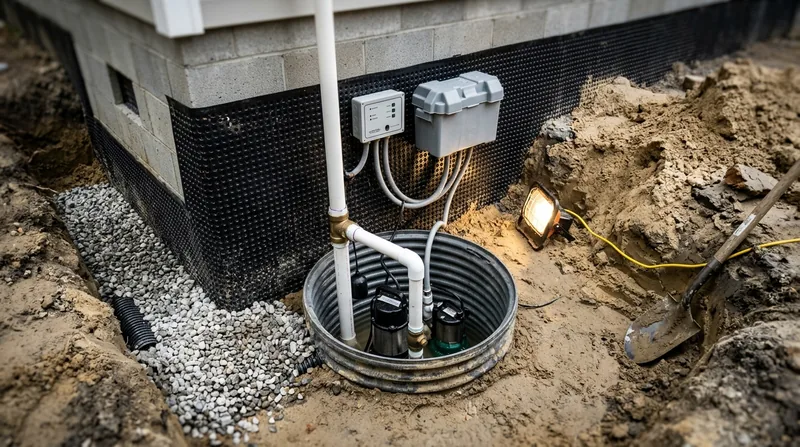




Battery Backup Sump Pumps in Wilmington
When a tropical system parks over New Hanover County and the grid goes down, your primary sump pump stops with it. That is the exact hour a Battery Backup Sump Pumps in Wilmington system earns its keep. Wilmington sits on sandy coastal plain over clay and shell, with the water table riding close to the surface, and most homes here are slab-on-grade or raised on brick-veneer foundation walls rather than full basements. Storm surge and days of rain saturate the sand faster than it drains, so a pit that handles a normal afternoon shower can be over its lid by midnight. We size, install, and service backup systems built for that reality, and we test them under load before we leave. Start with a sump pump installation and replacement review if your primary pump is already aging out.
Why Battery Backup Sump Pumps Matter on Wilmington's Low Coastal Lots
The failure mode that dominates here is not frost. It is a power outage during a multi-day rain event, when the water table lifts and every footing drain in the neighborhood is pushing water at once. Homes in Carolina Place and Forest Hills with old brick foundation walls, the 1960s to 1980s brick ranches across Myrtle Grove and Landfall, and the 1990s to 2020s slab subdivisions in Porters Neck and Ogden all share the same weak point: one pump, one circuit, one dead battery away from a wet floor.
- Storm outages knock out the primary pump precisely when inflow peaks, so the backup carries the load alone for hours or days.
- Hurricane season pushes surge and wind-driven rain through low lots, and the sand cannot absorb it fast enough to relieve hydrostatic pressure.
- Older brick-veneer walls wick moisture and show efflorescence, which tells you water is already moving through the masonry.
- A failed check valve or a clogged discharge line will defeat a backup pump just as fast as a dead battery will.
- Long vacations and vacant rental units leave nobody to notice a tripped breaker until the floor is wet.
A backup system buys you the hours between the outage and the crew's arrival, and that is the whole point of installing one.
Key info: In Carolina Beach and Kure Beach, storm surge can push water into the ground faster than any pump can move it, so we set the float height and alarm thresholds conservatively and pair the backup with a high-water alarm that you can hear from the living room.
For the state's own guidance on storm preparedness and power loss, see the North Carolina Department of Public Safety, Emergency Management resources.
How We Install a Backup System in Wilmington Without Guesswork
We start by measuring what your pit actually receives. A slab home in Ogden with a shallow basin and a short discharge run needs a different battery capacity than a raised brick-veneer cottage near the Cape Fear River with a deep pit and a long line to daylight. We check the primary pump's age, the check valve, and whether the discharge line has a freeze-resistant slope or a buried run that can back-siphon.
- We inspect the sump basin, measure pit depth and inflow rate, and confirm the primary pump's float and check valve are working.
- We size the backup pump and battery to your actual inflow, not to a one-size chart, and we match the voltage to the charger.
- We install the backup pump on its own float, set above the primary's trigger point so the two never fight each other.
- We wire a dedicated circuit, mount the charger and alarm where you can see and hear them, and label every breaker.
- We fill the pit and test both pumps in sequence, then confirm the battery holds charge under load before we pack up.
If the pit itself is undersized or the discharge line is failing, we tell you before we sell you a battery, because a backup on a bad pit just fails twice.
Key info: A homeowner in Porters Neck called after a nor'easter left the primary pump dead and the floor wet. The pit was fine, but the discharge line ran uphill and the check valve was shot. We replaced the valve, corrected the slope, and added a backup with a 12-hour runtime, and the next storm passed without a drop on the slab.
Pairing the backup with an interior drain tile system is often the smarter sequence when the pit is collecting water from more than one wall.
Backup Pump Options We Install in Wilmington
| Approach | Description | Best for |
|---|---|---|
| Battery backup pump | A second pump on its own float, driven by a deep-cycle battery and charger. | Homes with a working primary pump and a history of storm outages. |
| Combination primary and backup unit | One housing with two pumps and a shared controller in the same pit. | Older pits that cannot take a second drop pipe. |
| High-water alarm and float upgrade | An audible alarm plus a float set at the right trigger height. | Rental units and homes left vacant for weeks. |
| Discharge line and check valve correction | Re-sloping the line, replacing the valve, and extending the outlet away from the footing. | Pits that cycle constantly or back-siphon after each run. |
| Annual service and load test | Battery load test, float check, and a full wet test before storm season. | Every installed system, once a year. |
Battery Backup Sump Pumps Cost in Wilmington: What to Expect
Most Wilmington homeowners land somewhere around from $900 for a straightforward battery backup install on an existing, healthy pit, and the number moves from there. A deep pit with a long discharge run, a combination unit, or a correction to a failing check valve and line all add labor and parts. Getting two or three written estimates is the cheapest hour you will spend, because it forces each contractor to put the pit size, battery capacity, and alarm on paper.
Battery capacity is the biggest single driver. A unit sized for a few hours of inflow costs less than one built to run a full night during a stalled tropical storm, and the difference is honest runtime, not marketing. See our full pricing overview for the line-item detail behind these figures.
Choosing a Waterproofing Contractor Near Me in Wilmington
Ask three questions before anyone touches your pit. Are you licensed and insured, can you show me a certificate, and will you put the battery capacity and expected runtime in writing? A contractor who cannot answer all three is selling a box, not a system. Confirm whether the work touches the sanitary connection of the discharge, because that may require a permit from the local building department, and rules vary by jurisdiction, so verify before work starts.
Ask for references from homes with a similar foundation, slab versus raised brick-veneer, and call one. If you are in an HOA in Landfall or Porters Neck, check the architectural rules on exterior discharge outlets before the crew arrives. Reach out through our contact page and we will walk the pit with you.
Battery Backup Sump Pumps in Wilmington: Pricing Guide
| Service | Price | Details |
|---|---|---|
| Battery backup pump install | Starting at $900 | Includes pump, battery, charger, float, and a full wet test on an existing pit. |
| Combination primary and backup unit | Starting at $1,450 | Single-housing two-pump unit for older pits that cannot take a second drop pipe. |
| Discharge line and check valve correction | Starting at $350 | Re-sloping the line and replacing a failed valve that defeats any backup pump. |
| High-water alarm and float upgrade | Starting at $250 | Audible alarm and correctly set float for rentals and vacant homes. |
| Annual service and load test | Starting at $175 | Battery load test, float check, and wet test scheduled before storm season. |
| Complex or large-scale job | On estimate | Deep pits, long buried discharge runs, and multiple inflow points need an on-site look. |
Indicative pricing, the exact cost depends on square footage, finish, and site access. Free personalized estimate within 24h at (910) 765-8739.


