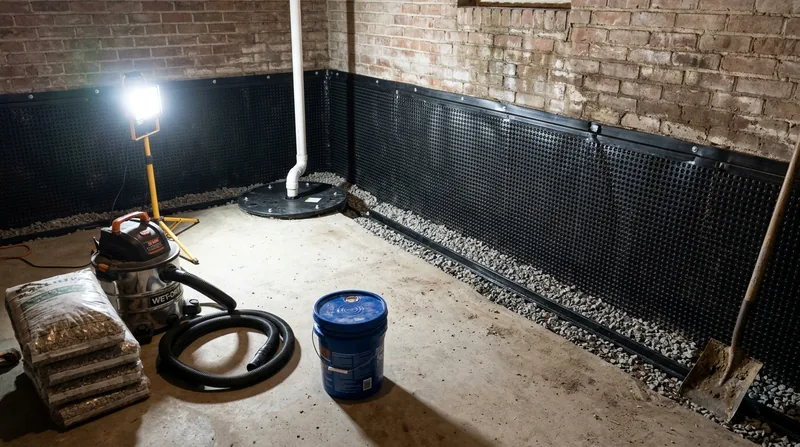




Wilmington sits on sandy coastal plain ground over layers of clay and shell, with the Cape Fear River, tidal creeks, and marsh close by. The water table sits near the surface, and a heavy summer storm or a tropical system can saturate that sand faster than it drains. Full basements are the exception here, but the homes that have one (older brick and frame cottages in Carolina Place and Forest Hills, below-grade rooms in 1960s to 1980s brick ranches around Myrtle Grove) take on water through the floor joint, the cove, and hairline wall cracks. Basement Waterproofing in Wilmington starts by finding the real water path, not by selling a system. We trace where the water enters, confirm whether hydrostatic pressure or a high water table is driving it, and build the right fix. If your home is slab-on-grade and the basement is not the problem, we say so. Start with a free basement inspection and we will tell you what the water is actually doing.
Why Below-Grade Water Shows Up in Wilmington Homes
The failure mode that dominates here is a rising water table during wet weather. When days of rain pile onto saturated sand, the water has nowhere to go but up and sideways into any below-grade space. On low lots near marsh or tidal creek, storm surge and heavy rain flood the ground before the soil can drain. Older brick foundations in the historic blocks were never built for that kind of sustained saturation.
- Water pushes through the floor-to-wall joint when hydrostatic pressure builds under the slab.
- Hairline cracks in brick and block walls weep during multi-day rain events.
- White efflorescence on the wall is salt left behind by water moving through masonry.
- A musty basement smell signals moisture trapped against the wall and floor.
- An aging footing drain or drain tile clogs with sand and silt and stops carrying water away.
- A sump pump that quits during a storm leaves the basin to overflow.
Each of those symptoms points to a different fix, which is why we diagnose before we quote.
Key info: A homeowner in Forest Hills called us after every heavy rain left a film of water across the basement floor. The walls were dry. The water was coming up through the floor joint because the water table had risen into the sandy subgrade. Sealing the crack alone would have failed. An interior perimeter drain and sump basin solved it.
For the local permit side of any structural or drainage work, verify requirements with the City of Wilmington's building department before work begins: City of Wilmington Planning and Development Services.
How We Waterproof a Wilmington Basement, Step by Step
We start below grade and work outward. The first visit is diagnostic: we map the water path, check the wall for bowing, test the sump pump, and look at grading and downspout discharge. Then we recommend the least invasive system that actually solves the problem. Sometimes that is crack injection. Sometimes it is an interior drain tile system. We tell you which and why.
- We inspect the wall, floor joint, cove, and any existing drain tile or sump basin.
- We identify whether the source is hydrostatic pressure, a high water table, or surface water feeding the foundation.
- We recommend crack injection, an interior perimeter drain, exterior membrane work, or a combination.
- We install the system, tie the discharge line to a legal outlet, and test the sump pump under load.
- We walk you through what was done and what to watch for during the next storm.
Every recommendation is written down, so you can compare it against other estimates.
Key info: In a 1970s brick ranch off Myrtle Grove, the footing drain had silted shut. Water was standing against the wall and pushing through the cove. We cut an interior perimeter drain into the slab, tied it to a new sump basin, and added a battery backup. The exterior excavation would have been four times the cost and no more effective on that lot. See how the interior drain tile system works.
Waterproofing Approaches We Use Below Grade
The right method depends on where the water enters and how the wall is built. Here is how the main approaches compare for Wilmington homes.
| Approach | Description | Best for |
|---|---|---|
| Interior drain tile system | Perforated pipe in a gravel trench cut along the interior footing, feeding a sump basin. | Hydrostatic pressure and a rising water table under the slab. |
| Exterior waterproofing | Membrane and dimple board applied to the outside wall, with footing drain and gravel. | Walls being repaired or rebuilt, and open excavation already needed. |
| Crack injection | Epoxy or polyurethane injected through ports to seal a leaking wall crack. | Isolated cracks with no broad pressure problem. |
| Sump pump and discharge | Sump basin, pump, check valve, and discharge line sized to the inflow. | Any system collecting water below the slab. |
| Vapor barrier and wall sealing | Moisture barrier and sealed wall treatment to control damp masonry. | Damp walls and humidity after the water source is controlled. |
We often combine two or three of these on the same job, because water rarely takes one path.
Basement Waterproofing Cost in Wilmington: What to Expect
Most below-grade jobs in Wilmington start from $2,500, and that figure usually covers a focused repair such as crack injection or a partial wall treatment. A full interior perimeter drain with a sump basin and discharge line runs higher, and exterior excavation is the most expensive route because it means digging out the wall. The number moves with the length of wall involved, whether a new sump pump is needed, how deep the footing sits, and how hard the site is to access.
Two things drive cost up fast on the coast: a high water table that demands a bigger pump and drain, and storm damage that has already bowed a wall. A bowing wall needs carbon fiber straps or wall anchors before any waterproofing will hold. Get two or three written estimates and compare the scope line by line, not just the total. Our full pricing overview breaks down what each system includes.
Hiring a Basement Waterproofing Contractor Near Me in Wilmington
A waterproofing contractor near Wilmington should be able to explain why your basement leaks before quoting a system. Ask for proof of license and insurance, and confirm the company carries general liability and workers' compensation. Ask what happens if the system fails after the first storm, and get the warranty terms in writing. Check references on jobs similar to yours, especially older brick foundations and slab-on-grade homes.
Permits vary by jurisdiction for structural foundation repair, egress window cutting, and any work that alters drainage or the sanitary connection of a sump discharge. Confirm with the local building department, and check any HOA rules before excavation. A contractor who hesitates on those questions is one to pass on. Reach us through the contact page to set up an inspection.
Basement Waterproofing in Wilmington: Pricing Guide
| Service | Price | Details |
|---|---|---|
| Crack injection (epoxy or polyurethane) | Starting at $2,500 | Includes port drilling, injection, and sealing of an isolated wall crack; length and number of cracks move the price. |
| Interior drain tile and sump basin | Starting at $4,500 | Perimeter trench, perforated pipe, gravel, sump basin, and pump; wall length and pump capacity drive the total. |
| Exterior basement waterproofing | On estimate | Requires excavation, membrane, dimple board, and footing drain; site access and wall depth need an on-site look. |
| Sump pump replacement with battery backup | Starting at $1,200 | New pump, check valve, discharge line, and backup unit; basin condition and discharge routing affect the figure. |
| Travel | Included | in Wilmington and surrounding areas, no separate call-out or mileage fee. |
| Estimate | Free | Response within 24h at (910) 765-8739, no obligation to book. |
Indicative pricing, the exact cost depends on square footage, finish, and site access. Free personalized estimate within 24h at (910) 765-8739.


